Initace
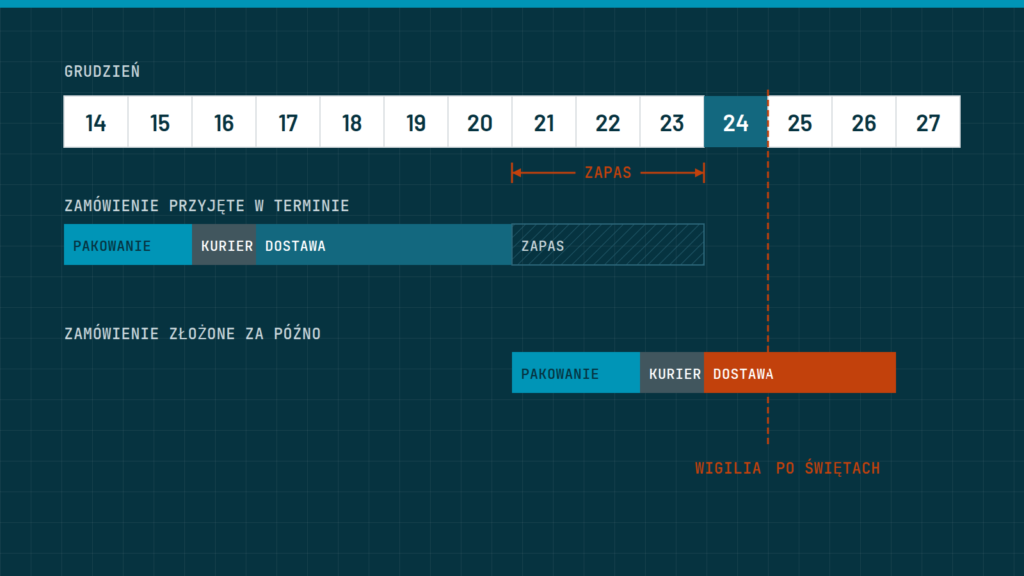
Christmas Eve 2026 falls on Thursday, 24 December, and since 2025 it has been a day off work in Poland, so carriers do not collect parcels that day. The store’s problem is that last year carriers announced their pre-Christmas posting deadlines only in December, while the customer needs a date earlier. So you set the last order day yourself, with a margin, and only correct it after the announcements. Below is a calculation of what that margin costs and what it costs to go without it. Everything here concerns a store selling in Poland: the carriers, the dates and the law are Polish.
Source: Christmas Eve as a day off from 2025 (KPMG Poland, read on 10 November 2026). The other figures are a calculation on our assumptions: a basket of 220 PLN, a 28% margin, 400 orders in December, worked out below.
What have the carriers announced for Christmas 2026?
As of 10 November 2026 we found no Christmas 2026 posting deadlines in the announcements of any of the main carriers. The news pages of InPost and Poczta Polska carry no such notice, and Orlen Paczka publishes none either. DPD Polska published a notice on 29 September 2026 titled “Tryb pracy DPD Polska w IV kwartale 2026” (DPD Polska’s operating schedule for the fourth quarter of 2026), but we could not read its content, so check it at the source. For DHL and UPS we found no deadlines for Christmas 2025 or 2026.
Last year InPost announced its guarantee on 8 December 2025 and Poczta Polska published its deadlines on 17 December 2025. The 2025 rules show what to expect, but they are not a promise for 2026. In the last column we converted them to the 2026 calendar (Christmas Eve on a Thursday instead of a Wednesday). That conversion is ours, not a carrier’s announcement.
| Carrier | Rule announced for Christmas 2025 | Converted to 2026 (not an announcement) |
|---|---|---|
| InPost, delivery to a parcel locker | Delivery guarantee before Christmas Eve for parcels posted on Monday, 22 December by a cut-off hour that depends on the postcode zone (zone A until 16:00, B until 15:00, C until 14:00, D until 13:00), delivered by Tuesday, 23 December. It does not cover delivery to an address, to a PaczkoPunkt pick-up point or international parcels. | posting by Tuesday, 22 December, delivery by Wednesday, 23 December |
| Poczta Polska | Certain delivery by 23 December: posting no later than Sunday, 21 December. As an exception, Monday, 22 December until 15:00 at points, lockers and post offices, or until 17:00 with a courier. | posting by Monday, 21 December, as an exception Tuesday, 22 December |
| DPD Polska | Parcels posted on Tuesday, 23 December were to be delivered only on Monday, 29 December; 24, 25, 26 and 27 December were days off. The notice gives no guaranteed date before Christmas. | no basis for a conversion; assume Poczta Polska’s deadline |
| Orlen Paczka, DHL, UPS | We found no official deadlines for Christmas 2025 or 2026. | ask your account manager and get a deadline in writing |
Sources: InPost’s notice of 8 December 2025, Poczta Polska’s notice of 17 December 2025 and DPD Polska’s notice of 14 October 2025 (all read on 10 November 2026 on the carriers’ own sites).
The InPost guarantee does not cover a courier to the door
The 2025 guarantee applied to delivery to a parcel locker. If most of your customers choose a courier to their home, InPost’s deadline does not apply to them, and the simple rule “the locker deadline for everyone” promises more than the carrier guarantees.
How do you set your own last order day?
The rule is simple: from the earliest carrier deadline you subtract one day of margin and the time to prepare the parcel in the warehouse, and you work it out separately for each delivery method. We assume a warehouse working Monday to Friday, one working day to prepare an order and one working day of margin (assumptions, use your own).
| Delivery method | Last posting with the carrier (converted) | Margin | Preparation | Last order day |
|---|---|---|---|---|
| InPost locker | Tuesday, 22 December | Monday, 21 December | Friday, 18 December | Friday, 18 December |
| Poczta Polska | Monday, 21 December | Friday, 18 December | Thursday, 17 December | Thursday, 17 December |
| Courier without an announcement | as Poczta Polska | Friday, 18 December | Thursday, 17 December | Thursday, 17 December |
If a carrier’s December announcement is more lenient, you can move the date later. The opposite, shortening the deadline after customers already know it, costs more in reputation than caution would have cost at the start.
What does an order that arrives after the holidays cost?
Take a store with a 220 PLN basket and a 28% margin, that is 61.60 PLN profit per order and 158.40 PLN cost of goods (assumptions, amounts excluding VAT for simplicity). The customer gets the gift after the holidays and withdraws from the contract. The store refunds all payments including the cost of delivery, so it bears the outbound shipment, 14 PLN (assumption), itself. We also assume the store pays 14 PLN for the return shipment and that handling the case takes 20 minutes of work at 60 PLN an hour. The result depends on what happens to the goods.
| Component of the loss | Goods go back on sale at a 15% discount | Seasonal goods, no chance of selling |
|---|---|---|
| Value of the goods | 33 PLN (discount) | 158.40 PLN |
| Shipment to the customer that nobody refunds | 14 PLN | 14 PLN |
| Return shipment | 14 PLN | 14 PLN |
| Handling the case | 20 PLN | 20 PLN |
| Total per order | 81 PLN (37% of the basket) | 206.40 PLN (94% of the basket) |
Suppose the store has 400 orders in December, about 13 a day, and that 5% of them (20 orders) arrive after the holidays (an assumption, not data). The loss is then 1,620 PLN in the discount variant and 4,128 PLN in the seasonal-goods variant. We deliberately do not count the lost customer, because we have no reliable figure for how many people do not return after such an event.
Conclusion for the owner
One day of earlier cut-off costs at most 13 orders at 61.60 PLN, about 820 PLN of margin, and that assumes none of those customers buys later or orders with a different deadline. It pays for itself when it protects against 10 late orders in the discount variant (10 × 81 PLN) or against 4 in the seasonal-goods variant (4 × 206.40 PLN). The more seasonal the range, the more an earlier deadline pays.
How does the right to return gifts work?
A consumer who bought at a distance may withdraw from the contract within 14 days without giving a reason (Article 27(1) of the Polish Consumer Rights Act). The period runs from taking possession of the goods, not from the day of purchase (Article 28(1)). For gifts this has simple consequences in money:
- Parcel delivered on 10 December: the right of withdrawal ends on 24 December, so the Act no longer requires a return of the gift after the holidays.
- Parcel delivered on 23 December: the customer may withdraw until 6 January, that is throughout the time when gifts reach the people they are for.
- Refund: the store returns all payments, including the cost of delivery, without delay and no later than 14 days after receiving the statement of withdrawal (Article 32(1)). It may wait with the refund until it gets the goods back or proof that they were sent back (Article 32(3)).
- Cost of the return: borne by the consumer unless the store agreed to bear it or did not tell the consumer about this cost (Article 34(2)).
- Made-to-order goods: there is no right of withdrawal for goods made to the consumer’s specification (Article 38(1)(3)), which changes the risk calculation for personalised products.
A longer return period, for example until the end of January, is a commercial decision of the store, not an obligation. We have no reliable data on how much such a promise raises sales or the number of returns, so we give no figure. The decision looks like this:
| Option | What you gain | What you risk |
|---|---|---|
| Statutory 14 days from delivery | the lowest cost of returns and the least work after the holidays | a customer buying a gift in advance may find the period too short |
| Extension to a set date after the holidays | a clear argument when buying a gift; you can state it in the cart | goods return in January, when staff and warehouse space are needed elsewhere |
| Extension and free return | the strongest argument for the undecided | at 14 PLN per return shipment each return is 14 PLN plus handling (the example above) |
The delivery date shown in the store binds you towards the customer
A store must give the consumer the manner and date of performance at the latest when the consumer expresses the will to conclude the contract (Article 12(1)(8)). That information is part of the contract and can be changed only by express agreement of the parties (Article 22). A “we will deliver before Christmas” date in the cart is therefore a commitment, not an advertising slogan. In the current text of the Act we did not find a general 30-day deadline for performing the contract, so do not rely on such a provision without a lawyer’s opinion.
Where do you show the date in the store and what does it change in money?
Slow delivery is one of the main reasons for leaving with a full cart: according to the Baymard Institute, 20% of US shoppers who abandoned a cart name it, and in Gemius’s “E-commerce w Polsce 2026” (E-commerce in Poland 2026) survey long delivery time irritates 30% of Polish shoppers. A date shown where the customer decides answers that worry before the customer leaves. These are the places, from the most important:
| Place | What to show | What it changes |
|---|---|---|
| Cart, at the choice of delivery | a separate date for each method, for example “order by Friday, 18 December” | this is where the customer chooses; the date becomes part of the contract (Articles 12 and 22), so it must be cautious |
| Product page | the date next to the “Add to cart” button; for made-to-order goods a separate, longer one | removes the doubt before the item goes into the cart |
| Banner at the top of the page | one sentence with the earliest date and the day of the week | informs also those who will not get as far as the cart |
| Order confirmation e-mail | the expected dispatch and delivery date | reduces the number of “where is my parcel” questions |
In PrestaShop you set the delivery time at the carrier and on the product page, and in WooCommerce you switch on the store notice in the appearance settings of a classic theme; dates that depend on the hour and the day of the week need a contractor’s work. Also prepare three texts for the day after the deadline and set the day they switch on: “we ship after the holidays”, a gift voucher sent by e-mail and the dates the warehouse is closed. Changing the texts at night, while orders keep coming in, costs you orders placed under a false impression.
What happens at the peak to customer service, the warehouse and payments?
The only hard data we found come from Poczta Polska and describe December 2025:
Source: Poczta Polska’s notice of 23 December 2025 (read on 10 November 2026). The same notice says that 95% of courier parcels to a home arrived on the next working day, and more than 98% of those to pick-up points.
The conclusion is that the last week before the deadline is the worst moment for any change in the store and for a new employee without induction. We found no data on payment failures or on customer-service load at the peak, so we give only the decisions that follow from the calculation above:
- Staff the warehouse and customer service for 15–21 December according to the busiest week, not the average.
- Freeze changes in the store from 27 November (our rule of caution, not a requirement): every update during the season risks stopping the checkout, and the calculation is in Updating your store without risk.
- One test order a day with BLIK and with a card, so that you see a payment failure before your customers do. Checking payments is covered in Failed payments in your store.
- Stock levels: mark them so that the store does not sell goods you cannot deliver. See Stock synchronisation.
- Store performance under heavier traffic: Will your store survive Black Friday.
Want someone to look at your store through a customer’s eyes before the season starts? A shop audit covers the product page, cart, checkout, payments and delivery, including whether the cost and time of delivery are visible before the cart and how the store looks on a phone. You get a list of places to fix with a screenshot, the urgency and the price of each fix. The shop audit costs €450 net and the result comes in 10 working days counted from the day we have access. Ordered by 13 November, with access the same day, it gives a result by 27 November. See what we check and what you get.
What to do by when?
The calendar runs from today to Christmas, and the deadline dates rest on the conversion in the table above.
- Friday, 20 November. Ask each carrier in writing for the posting deadline before Christmas Eve and for pick-up hours in December. Decide whether you extend the return period.
- Friday, 27 November. Finish changes to the store and take a backup. Go through a purchase on a phone with every payment and delivery method.
- Friday, 4 December. Show a provisional last order date for each delivery method in the cart and on the product page. Prepare the texts for the day after the deadline.
- 8–17 December. Watch the carriers’ announcements; in 2025 InPost announced on 8 December and Poczta Polska on 17 December. Correct the dates in the store within one working day.
- Thursday, 17 December. Last order day for Poczta Polska and for a courier without an announcement (conversion).
- Friday, 18 December. Last order day for an InPost locker (conversion). Switch on the “after the deadline” texts.
- Monday, 21 and Tuesday, 22 December. Last postings and the last working day of the warehouse before the holidays.
- Thursday, 24 – Sunday, 27 December. Carriers do not work (according to DPD’s 2025 schedule: days off from 24 to 27 December).
- Until Wednesday, 6 January. Returns of gifts delivered on 23 December. Record how many orders came after the deadline, because it is your data for next year’s plan.
In short: carriers announce their deadlines in December, so set the last order day yourself, with a working day of margin, separately for each delivery method. In the example one order after the holidays costs 81–206 PLN and a day of margin at most 820 PLN of margin. The date shown in the cart binds you towards the customer, and the right of withdrawal lasts 14 days from delivery.
In the season, reaction time matters. In our store care plans we reply within 4 hours, weekends included, when sales are blocked. Care for a WooCommerce shop costs €145 net/month, and for a PrestaShop shop €190 net/month. See what the care covers or book a 15-minute call, and we will tell you what in your store is worth checking before the season.